

How does it work?
According to Yang & Metros (2006), the most successful mentorship relationships are the ones in which participants:
1) Connect - Mentors and students are encouraged to have a relationship commitment of six months to one year, with frequent contact for the duration of the relationship to establish a strong bond,
2) Communicate - Communication is respectful, so both members feel their viewpoints are heard and valued, and
3) Engage - Participants take part in online collaborations rooted in shared goals, aligned expectations, and mutual benefits.
To ensure a successful mentorship experience for all participants, COMPASS matches adult mentors with one to three immigrant secondary students using a data-informed approach based on information gathered from COMPASS profiles and a short questionnaire taken during the onboarding process. Matches are based on ethnic background, preferred language, learning style, and hobbies and interests.
COMPASS allows mentor-student pairs that may be separated geographically to communicate virtually using the mobile application. That increases the pool of potential participants by removing time and location constraints.
Each pair has access to a private space for sending messages and a public discussion forum, which provides participants with a supportive community of mentors and students, as well as to the site coordinator and management team that performs regular check-ins to ensure the quality and consistency of mentorship.
CURRICULUM
The COMPASS curriculum is imposed through facilitated discussion forums and was designed to promote learning through a collaborative, conversation-driven environment based on the Community of Inquiry (COI) framework (Garrison et al., 2000), a social constructivist model of learning in online environments, which represents a process of creating a deep and meaningful learning experience through the development of three interdependent elements – teaching, cognitive and social presence (see Figure 1). It aims to provide culturally-centered support that these newcomer secondary students need by emphasizing quality dialogue that focuses on establishing clear goals, knowledge sharing, and community building while meeting the participants' immediate needs.
Figure 1.
Community of Inquiry adapted for a Mobile Mentoring App
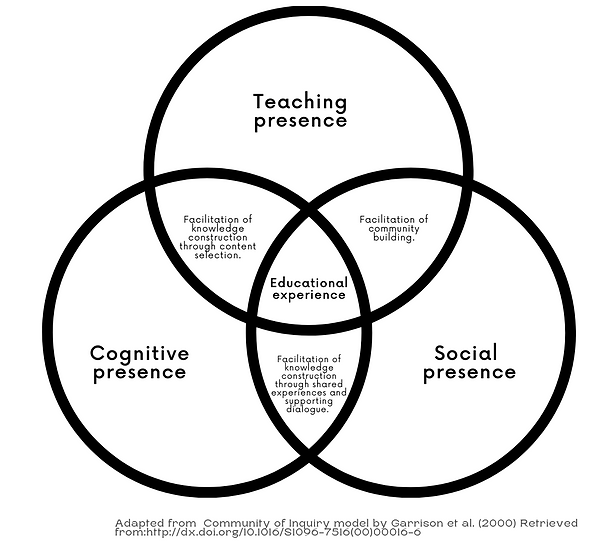
Community of Inquiry
Teaching presence
The design, implementation, and facilitation of content and curriculum.
App features:
- Leading and learning by example
- Awareness of students' needs and challenges
- Mentor feedback
- Mentor availability (i.e., dates and times) and contact methods
- Regular check-in service by the COMPASS management team
- Highlights reel acknowledging mentor and student contributions
Cognitive presence
The extent to which students individually and socially construct new knowledge.
App features:
- Support defining student goals and learning objectives (i.e., mentors teaching students how to use the SMART method)
- Knowledge building in different contexts
-Low-stakes formative assessments (i.e., polls, quizzes, vlogs, etc.) to promote student engagement
- Reflective writing that includes topics like well-being, culture, education, and careers.
- Access to continuous learning anytime, anywhere
Social presence
The ability of students to express themselves to a person like them, who knows what they are going through, and engage in open communication and collaboration.
App features:
- Community building
- Networking opportunities
- Contextual learning through authentic interactions
- Mediated connections between students' personal experience and the experience of the larger community
- Centralized communication channels
-
private chat function
-
shared/public discussion forum
- Clear guidelines for mentor-student behaviour (i.e., Code of Conduct)
- Incident support (i.e., reporting system)
How learning happens...
The use of mobile devices as tools in teaching and learning is known as mobile learning. Mobile learning (or m-learning) has been defined as “Any sort of learning that happens when the learner is not at a fixed, predetermined location, or learning that happens when the learner takes advantage of learning opportunities offered by mobile technologies” (O’Malley et al., 2003, p. 7). A key point in m-learning theory is its focus on the mobility of the learner— giving them the ability to access content however and whenever they choose (Shuler, 2009).
At a pedagogical level, the use of mobile devices for virtual mentoring opens the possibility of engaging immigrant secondary students in technology-mediated social interaction and collaboration for learning (Burden et al., 2019). Figure 2. illustrates the social factors and learning activities involved in the collaborative construction of knowledge while using the COMPASS app.
Figure 2.
.png)

ETHICS
COMPASS handles the registration, pairing, managing, and reporting of a mentoring relationship. But, matching a mentor and student using a mobile device requires a lot of careful consideration.
Cormack (2020) notes that using a mobile device brings an element of concern for safety and privacy for those engaging in online relationships. For this reason, risk management is a critical component of COMPASS design.
For preventing and reporting online safeguarding incidents or concerns, COMPASS has included the following features:
1) Screening - COMPASS ensures that the recruitment, screening, training, and pairing processes are extensive and comprehensive.
2) Code of Conduct - COMPASS has a policy clarifying expectations of student and mentor behaviour, online as well as offline, and the consequences of failing to adhere to these standards (Cormack, 2020).
3) Reporting channels - COMPASS will provide channels where students and mentors can report concerns and incidents, either online or by telephone (Cormack, 2020). In addition, conversations can be flagged to immediately connect with a member of the COMPASS management team.
4) Tracking - COMPASS measures the frequency and duration of chats and calls, scheduled meetings, access to learning resources, and information about whether mentoring relationships are active and beneficial or require intervention or discontinuation. All personal data is contained within a safe and secure e-mentoring environment to protect participants' confidentiality and privacy, and is not shared with third parties.
5) Measurements - COMPASS uses the data collected from the tracked activity explained above to evaluate the overall health of the mentoring program and improve mentorship outcomes.